


September, 2026 – You may remember Henry Kissinger and his famous stance of Realpolitik, especially in his dealings with communist China. But I would argue that the original Realpolitician was Niccolò Machiavelli, who was born in the late 15th century. His masterwork, The Prince, was not published until after his death, which was smart because it would probably have caused his death had he been alive. Maybe you’ve heard Machiavelli's most famous quote: "It is better to be feared than loved, if you cannot be both.”
However, there is another quote of his that has been on my mind as of late: "Wars begin when you will, but they do not end when you please." Maybe Trump never read The Prince, but I think the whole world is witnessing that lesson evolve.
Obviously I am referring to the quagmire in the Middle East and the war with Iran. Is the Strait of Hormuz open or closed? The answer is yes. The fact that 20% of the world’s seafaring oil transits the strait doesn’t affect the U.S. much directly, but indirectly you have seen our gas prices. You have seen YOUR gas price, which is undoubtedly unleaded, but check the price of diesel next time you’re at the pump.
Everything at the grocery store, everything at the pharmacy, and everything pretty much everywhere else is delivered—you guessed it—by truck. What do these trucks run on? Right again. Diesel.
So, on top of all the inflation we’ve endured since the pandemic—which remember is simply an increase in the money supply—we’ve got all these additional gas hikes, which act like brakes on the economy. It’s just as well that half the country’s taking appetite suppressants, as we can no longer afford food.
But don’t tell the A.I. industry. As far as they are concerned, there is no stopping this bull run. And so far, so good. A.I. chips are still selling, and earnings are still increasing (though the calculations are suspect). Now the infrastructure buildout for data centers has begun in earnest, and some experts are claiming that A.I. infrastructure may become its own asset class—a combination of the tech sector and commercial real estate. Makes sense.
Maybe this reminds you of the similar race to expansion we saw in the late 1990’s, when the internet craze fueled the country. The conduit became the commodity. Which is to say, one could go on the internet (the conduit) and buy internet stocks (the commodity). This elevated the prices on internet stocks even higher than they otherwise would have been by creating a feedback loop, very similar to what we are seeing today with the A.I. industry. When has a boom ever stopped on a dime? Never.
PriceWaterhouseCoopers recently announced that “global spending on AI infrastructure is expected to reach a whopping $31.6 trillion through 2050,” according to their projections. Right now, annual data center capital expenditure lands roughly at $800 billion, but that’s expected to increase to $1.8 trillion in 2050.[i]
That indeed sounds like a lot of money, but pales in comparison to how much the federal government is blowing through. The government’s fiscal year 2026 runs October 1, 2025 – September 30, 2026, so we're near the end of it now (September 2026).
Total spending for the whole of FY 2026 is budgeted at $7.54 trillion, though an earlier CBO projection put it closer to $7.4 trillion.[ii] This adds another $2 trillion to the debt, which as you know just passed the $40 trillion mark.
This is why the global bond market is melting down. Have you heard anything about soaring bond yields in the news? Remember that bond yields and prices are inversely related, so higher yields mean bond prices have dropped. And indeed, this has happened to every sovereign debt instrument in the world. There is just too much debt—the bond market is telling us we have reached the limit. Not just us, but the whole world.
So now what do we do? We, being the whole global economy. No one knows.
The war with Iran is escalating and widening. The Iran-backed Houthis have seized virtually all of Yemen's Red Sea coast and the Bab el-Mandeb Strait — Saudi Arabia's backup export route — while a drone attack from Iraqi territory knocked the kingdom's East-West pipeline offline for weeks. Houthis and Saudi forces are trading missile and air attacks, and the Houthis are denying a Saudi claim they tried to drone Mecca.[iii]
The other Mid-East players who have been attacked repeatedly by Iran—Saudi Arabia, Bahrain, Kuwait, Oman, Iraq, Jordan, and even Turkey—have been remarkably non-combative in the face of such attacks. But now, Saudi Arabia has no choice but to respond militarily to the Houthi seizure, and this will further escalate the situation.
The hard truth of it is that we—the USA—are stuck. If we go home, Iran will just take the Strait back. We have to stay to keep it open, and sitting out there in the water isn’t going to change anything. We’re going to have to put boots on the ground in order to change the regime, but nobody wants to say this because nobody wants to hear it. Trump wants the people to rise up and overthrow the regime, but everybody that could and would is already dead. He called them up way too early. They listened, and then they were liquidated in short order. I’m not sure this “boots on the ground” reality has sunk in yet.
To make things even more interesting, the midterm elections are right around the corner. There is a high likelihood that the Republicans will lose the House, in which case we will be deadlocked, and you won’t get your $5000 bonus. How that will end up affecting our “war that is not a war” I don’t know, but I feel confident we will see more impeachment hearings.
Gold and silver peaked back in late January, with gold reaching $5,600 per ounce and silver reaching $121 per ounce!
Since then, they have backed off those highs and gold is now around $4,350 and silver around $67.
The uncertainly around all these aforementioned factors, the ever-changing tariffs, the disaster in Ukraine, our unhappy neighbor to the north, and especially the widespread knowledge that stocks have only been this expensive twice before—once in 1999 and again in 1929—has sidelined a lot of money.
A lot of money.
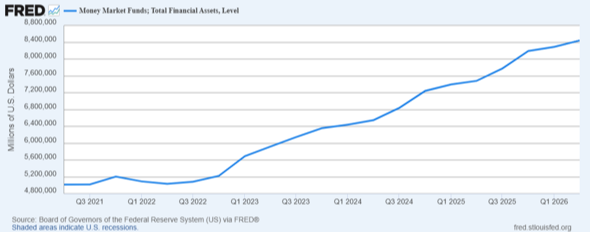
The first chart below is the amount that is invested in money market funds: a cool $8.4 trillion!
The next chart indicates how much is invested in T-Bills, which essentially back up all the money market funds. T-Bills act like cash, and this is where most institutional investors park cash, like us. Note that the number is delineated in millions of dollars, so that would equal about $5.5 trillion.
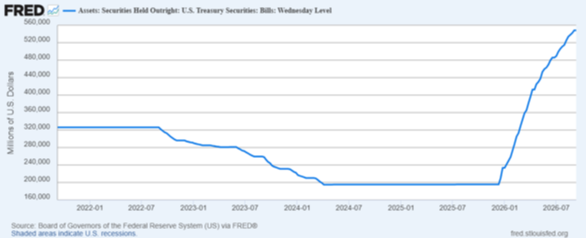
Chart number three represents savings accounts and CDs held at banks and credit unions. Note that this is also delineated in millions of dollars, so that would equal $8.8 trillion.
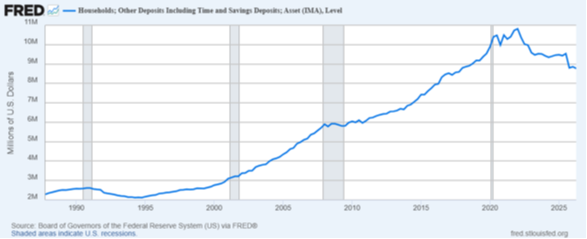
If we do the math, that’s a whopping $22.7 trillion! What if only half of this money flows out? And into what? Real estate? Stocks? Bonds? Cars? Cruises? Food? Home renovations? A.I. infrastructure? All of the above? You name it—prices will soar.
Clearly the investors who have parked cash here are waiting on something. If they’re like Warren Buffet, they’re waiting for a buying opportunity. What might that look like? A 10% drop? A 20% drop? Surely a 30% drop would draw some of that money out, right?
Of course, in times past, particularly in 2000 and 2008, investors were willing to sit it out and wait for a 50% drop in some sectors. In fact, we saw this in the tech sector as recently as 2022.
Finally, yesterday the Fed raised interest rates by another ¼ point to 3.75%. All indications are that this will continue. This is not good news for bonds or our massive debt, but hopefully it will buy a few more years for the dollar. Sadly, its days are numbered.
I’m not trying to be Debbie Downer, but we, being the USA, are in quite the pickle:
U.S. stocks are way overpriced. The whole global bond market is in crisis mode and melting down. Our national debt just hit $40 trillion, and oil is hovering over $100 as the conflict widens with no end in sight. Nothing is certain except that the dollar is losing value. AND there's $22 trillion in cash. AND interest rates are going up. What to do? Everyone is scratching their head and looking at each other in confusion and consternation.
If you were expecting a solution at this point, I’m sorry to disappoint. There aren’t even any good ideas. A few weeks ago, the US Treasury had to help Japan raise some money so they wouldn’t be forced to sell our treasuries, because there are no buyers. Their only thoughts seem to be patch work—and it works for a few hours, maybe a day, but that’s it.
A game of whack-a-mole anyone?
In any event, we are here to keep you informed of the good, the bad and the ugly without sugar coating it and I think you’ve got that here. Somehow, someway, we’ll make it through—hopefully with some lessons learned, but probably not.
If you have questions or concerns, I certainly encourage you to contact me at kevin@magellanplanning.com or 404-257-8811.
As always, we wish you well and hope to see you soon at one of our upcoming events.
Sincerely yours,
J. Kevin Meaders, J.D. CFP ®, ChFC, CLU
The views and opinions are those of J. Kevin Meaders, J.D., CFP®, ChFC, CLU and should not be construed as individual investment advice, nor the opinions/views of Magellan Planning Group, Inc. All information is believed to be from reliable sources; however, we make no representation as to its completeness or accuracy. Additional risks are associated with international investing such as currency fluctuation, political and economic stability, and differences in accounting standards. Due to volatility within the markets mentioned, options are subject to change without notice.
Investors cannot invest directly in indexes. The performance of any index is not indicative of the performance of any investment and does not take into account the effects of inflation and the fees and expenses associated with investing. S&P 500 – A capitalization-weighted index of 500 stocks designed to measure performance of the broad domestic economy through changes in the aggregate market value of 500 stocks representing all major industries. Dow Jones Industrial Average, Dow Jones, or simply the Dow, is a price-weighted measurement stock market index of 30 prominent companies listed on stock exchanges in the United States. The Nasdaq Composite is a stock market index that includes almost all stocks listed on the Nasdaq stock exchange. The Nasdaq Composite is a stock market index that includes almost all stocks listed on the Nasdaq stock exchange.
Magellan Planning Group, Inc is a SEC Registered Investment Advisor. Estate services offered by Magellan Legal, LLC and tax services offered by Magellan Tax, LLC.
The return and principal value of bonds fluctuate with changes in market conditions and interest rates. If bonds are not held to maturity, they may be worth more or less than their original value.
[i]https://www.wsj.com/cio-journal/ai-infrastructure-will-cost-trillions-more-f16af49